

L4 L5 Disc Bulge Explained — What Your MRI Report Actually Means
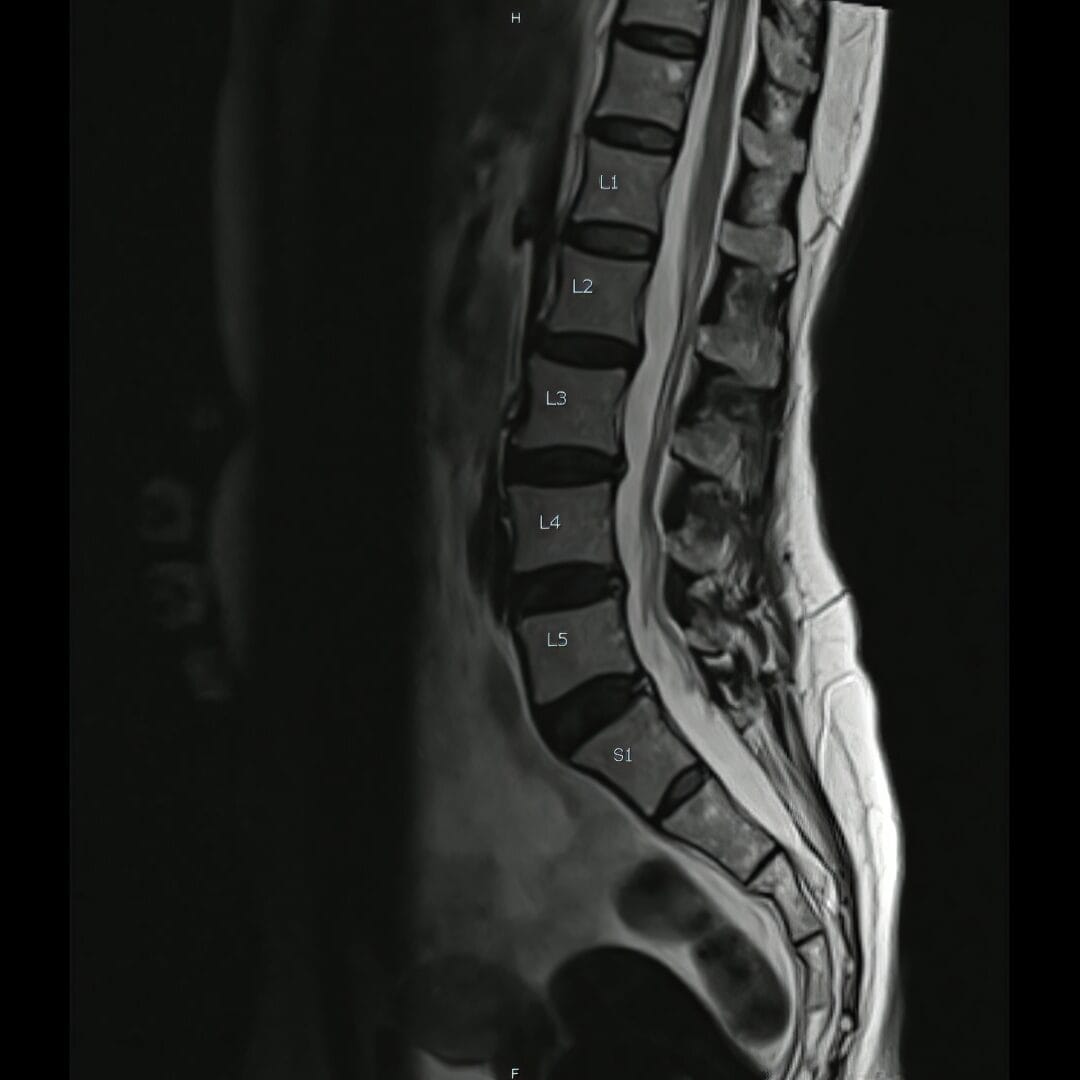
You came back from an MRI with a report that says "L4-L5 disc bulge" or "disc herniation at L4-L5 level." Now you are sitting at home trying to decipher what that actually means — whether it is serious, whether you need surgery, and what happens next.
You are not alone. L4-L5 disc bulge is one of the most common findings in adults across India who get an MRI for lower back pain. The problem is that most patients leave with the report but without a clear explanation. This guide changes that.
First — The Reassuring Fact Most Doctors Don't Tell You
Before anything else, here is something important about disc bulges and MRI findings.
This does not mean disc bulges are harmless or can be ignored. It means that an MRI finding alone does not determine how you should be treated. What matters is whether your specific bulge is pressing on a nerve and causing your symptoms — and that requires a clinical examination, not just an imaging report.
Many patients have been told they need surgery based on an MRI finding alone. That is not the right approach. Equally, many patients dismiss a bulge because they have "heard it is common" — and then ignore symptoms that genuinely need attention. The truth sits between both extremes, and only a specialist evaluation can place you accurately on that spectrum.
Where Is L4-L5 and Why Does It Matter?
The lumbar spine has five vertebrae — L1 at the top through L5 at the bottom. Between each pair of vertebrae sits a disc. The L4-L5 disc sits between the 4th and 5th lumbar vertebrae, near the base of the spine, roughly at belt level.
This location matters for one key reason: the L4-L5 segment bears the majority of the mechanical load during bending, lifting, twisting, and sitting. It is responsible for most of the flexion and rotation of the lower back. Because it is the most stressed level in the lumbar spine, it is also the most frequently damaged — which is why so many MRI reports mention it.
Reading Your MRI Report — What the Terms Mean
MRI reports use technical language that is not explained to patients. Here is a plain-language translation of the terms you are most likely to see.
Disc herniation / protrusion — disc material has pushed through a weakened area of the outer ring.
Disc extrusion — inner disc material has broken fully through the outer ring.
Thecal sac indentation — disc is touching the protective covering around the spinal cord.
Nerve root compression — disc is directly pressing on a spinal nerve.
Diffuse disc bulge — disc bulging symmetrically in all directions.
Focal disc bulge — bulge in one specific direction, more likely to compress nerves.
Disc desiccation — disc has lost water content; early sign of disc degeneration.
Foraminal narrowing — the opening where nerves exit the spine is narrowed by the disc.
Mild / moderate / severe — refers to the degree of canal or nerve compression.
What Causes L4-L5 Disc Bulge?
Disc bulges do not happen overnight. They develop gradually through a combination of age-related changes and mechanical stress applied over years.
Contributing factors
- Age-related disc degeneration — discs lose water content and elasticity over decades; this is the primary underlying cause
- Prolonged sitting — increases disc pressure significantly, accelerating degenerative changes at L4-L5 specifically
- Heavy or repetitive lifting — incorrect technique creates acute and cumulative disc stress
- Poor posture — sustained spinal misalignment increases posterior disc loading
- Obesity — increased axial load on lumbar discs with every step and every hour of standing
- Smoking — reduces blood supply to discs, impairing nutrition and healing capacity
- Genetics — disc composition and resilience are partly inherited
- Trauma or sudden injury — can trigger herniation in a disc that was already degenerating
L4-L5 Disc Bulge Symptoms — What You Might Feel
Symptoms depend entirely on whether the bulge is pressing on a nerve and, if so, which nerve. A bulge that does not touch any nerve may produce no symptoms at all. One that compresses the L5 nerve root produces a very specific pattern.
Lower Back Pain
Aching or sharp pain centred in the lower back, often worse with sitting, bending, or prolonged standing
Sciatica
Pain radiating from the buttock down the back or side of the leg, sometimes reaching the foot
Foot Weakness
Difficulty lifting the foot upward (foot drop) — a specific sign of L5 nerve compression at this level
Toe Weakness
Weakness in extending the big toe — another characteristic L5 nerve finding at L4-L5
Numbness or Tingling
Running down the outer thigh, outer shin, or top of the foot — L5 distribution
Pain Worse with Sitting
Sitting increases disc pressure by approximately 40% — making L4-L5 symptoms significantly worse in seated positions
A key clinical point: the L4-L5 level most commonly compresses the L5 nerve root. This is why foot drop and great toe weakness are red flags that specifically point to this disc level. If these are present, a specialist evaluation should not be delayed.
Seek Immediate Evaluation
- Loss of bladder or bowel control — possible cauda equina syndrome, a surgical emergency
- Sudden weakness or inability to lift the foot (foot drop)
- Rapid progression of leg weakness within hours or days
- Numbness in the groin or inner thighs (saddle anaesthesia)
These signs indicate serious nerve compression. Call 8686868208 or visit Pure Ortho Hospitals 24x7 emergency immediately.
How Serious Is Your L4-L5 Disc Bulge?
Severity is not determined by the MRI report alone. It is determined by the combination of imaging findings, clinical examination, and what the patient is actually experiencing. The same MRI finding can mean very different things in two different patients.
Disc bulge without nerve contact
Likely manageable with conservative treatment. May improve significantly without surgery.
Bulge touching but not compressing nerve
Symptoms likely present. Conservative treatment appropriate. Monitoring important.
Active nerve root compression
Symptoms typically present. Treatment depends on duration and response to conservative care.

Does an L4-L5 Disc Bulge Require Surgery?
This is the question most patients want answered immediately after receiving their MRI report. The honest answer: most do not.
The large majority of L4-L5 disc bulge cases improve significantly with conservative treatment — physiotherapy, pain management, activity modification, and time. Surgery is considered when conservative treatment has been properly implemented and has failed over a defined period, or when there are signs of progressive nerve damage that cannot wait.
Treatment options your spine specialist may discuss
- Physiotherapy — targeted strengthening, flexibility work, and movement retraining
- Pain management — anti-inflammatory medication, nerve pain management as appropriate
- Activity modification — reducing postures and movements that increase disc pressure
- Epidural steroid injection — targeted injection to reduce nerve inflammation in selected cases
- Endoscopic discectomy — minimally invasive surgery removing the portion of disc pressing on the nerve
- Microdiscectomy — microsurgical removal of herniated disc material under magnification
- Spinal fusion — considered in cases with significant instability; less common for isolated disc bulge
At Pure Ortho Hospitals, the surgical team is clear with patients: surgery is recommended when it is genuinely indicated — not because an MRI shows a disc bulge. Many patients who arrive expecting surgery leave with a physiotherapy plan that delivers the outcome they needed.
What About L4-L5 and L5-S1 Together?
It is common for MRI reports to mention both L4-L5 and L5-S1 disc problems in the same patient. This is because both levels are high-load segments that share similar mechanical stressors. Having findings at both levels does not automatically mean the problem is twice as serious — it means the lumbar spine has experienced cumulative stress at multiple levels, which is very common in adults over 40.
Treatment is still based on which level is actually producing symptoms and which level's disc is causing the nerve compression. This requires clinical correlation — matching what the MRI shows to what the physical examination finds. An MRI that shows two levels cannot tell you which one is causing your pain. A specialist examination can.
For a full explanation of L5-S1 specifically, see our related article on slip disc symptoms and causes.
Recovery — What to Realistically Expect
For patients managed without surgery, recovery follows a gradual course. The disc does not return to its original shape — but the inflammation around the nerve can resolve, the body can partially compensate, and the symptoms can improve substantially or completely.
General conservative recovery timeline
- Week 1-4: Acute phase. Pain management, gentle activity, avoid aggravating positions
- Week 4-8: Physiotherapy progresses. Pain typically reducing in most patients
- Month 2-4: Strength and mobility improving. Functional recovery ongoing
- Month 4-6: Most patients with mild to moderate findings reach significant relief
- After endoscopic surgery: Return to light activity within 1-2 weeks; full recovery 6-8 weeks
Meet the Specialists at Pure Ortho Hospitals
L4-L5 disc problems are managed by the Spine and Orthopaedic team at Pure Ortho Hospitals, with physiotherapy and pain management integrated from the start.
Dr. Sai Krishna C.S
MS Ortho (University Gold Medalist), DNB Ortho, Fellowship in Spine Surgery
Dr. V.S. Abhilash Kumar S
MBBS, MS Ortho, FIJR, FISS (S.Korea, USA) — Clinical Director
Dr. G. Uday Sekhar Reddy
MBBS, MS Ortho, MCh Ortho
Dr. Pudari Manoj Kumar
MBBS, MS Ortho, FIJR, FIRJR
Dr. L. Sreeram
MPT (Ortho), FDOR, MIAP
Dr. L. Sri Dharani
BPT, MIAP, PTOTA (Canada)
Frequently Asked Questions
Other Departments at Pure Ortho Hospitals
Spine care at Pure Ortho Hospitals is supported by a complete orthopaedic and medical team under one roof.
Understand Your MRI Report — Get Properly Evaluated
An MRI finding is only half the picture. The other half is a clinical examination by a specialist who can tell you what your L4-L5 disc bulge actually means for you — and what the right next step is.
Call 8686868208More from Pure Ortho Hospitals
This article is for patient education only. Please consult a qualified spine specialist before making any treatment decisions.