

Robotic Knee Replacement in Hyderabad — Everything You Need to Know
The knee replacement procedure has been performed for over 50 years. In that time the implants have improved dramatically — better materials, better designs, longer-lasting bearings. But until robotic systems became widely available, the precision of implant placement still depended entirely on the surgeon's manual technique and the accuracy of mechanical alignment guides. Robotic knee replacement changes this fundamental limitation.
In Hyderabad, robotic knee replacement is available at Pure Ortho Hospitals, Sainikpuri — where the surgical team includes a Clinical Director with fellowship training in South Korea and the USA, and a Chairman with international fellowship training in Germany. This guide covers what the technology does, what makes it different from conventional replacement, who is a candidate, and what the full experience looks like from first consultation to return to full activity.
What Is Robotic Knee Replacement?
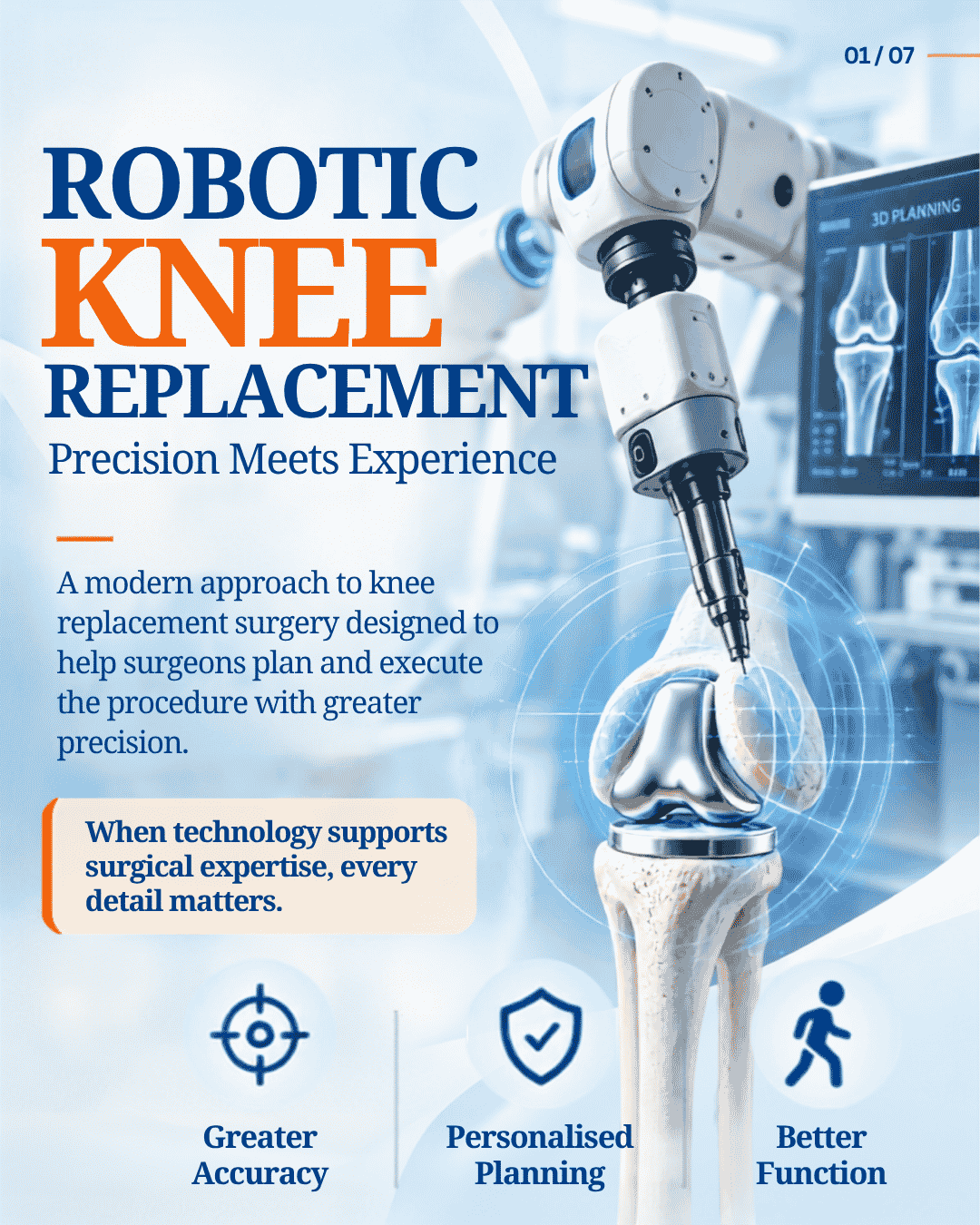
Robotic knee replacement — formally called robot-assisted total knee arthroplasty — is a surgical technique that combines pre-operative CT-based 3D planning with intraoperative robotic arm guidance to place the knee implant with precision that exceeds what conventional manual technique can reliably achieve.
Two things make it different from conventional knee replacement. First, before surgery, a CT scan of the patient's knee is used to create a personalised 3D model of their specific anatomy. The surgeon uses this model to plan the exact position, angle, and size of the implant before entering the operating theatre — eliminating the guesswork of intraoperative decision-making. Second, during surgery, the robotic arm guides the bone cuts to match the pre-operative plan precisely, restricting movement to the planned surgical zone and providing real-time feedback if the surgeon moves outside it.
Robotic vs Conventional Knee Replacement — The Key Differences
Robotic Knee Replacement
- CT-based 3D plan specific to your knee anatomy
- Implant position planned before surgery begins
- Robotic arm guides bone cuts to within 1mm of plan
- Real-time intraoperative feedback and adjustment
- More accurate alignment and rotation of implant
- More natural knee feel post-surgery in many patients
- Valuable for complex anatomy and deformity
- Reduced soft tissue damage from precise cuts
Conventional Knee Replacement
- Standard X-ray-based pre-operative planning
- Mechanical alignment guides used intraoperatively
- Bone cuts guided by surgeon's judgement and instruments
- No real-time feedback on cut accuracy
- Good outcomes in experienced hands
- Established long-term outcome data
- More widely available
- Lower upfront cost in some centres
The critical variable robotic replacement addresses is alignment accuracy. Research consistently shows that robotic systems achieve implant placement within 1-2 degrees of the planned position — tighter than conventional technique. This matters because implant alignment is one of the strongest predictors of long-term survival. An implant placed 3-5 degrees off the ideal position wears unevenly and is more likely to loosen, become painful, or require revision within 10-15 years. Robotic technique reduces this risk significantly.
How the Procedure Works — Step by Step
CT Scan
A CT scan of the knee is taken 2-3 weeks before surgery. This creates a precise 3D model of the patient's individual bone anatomy.
3D Planning
The surgeon uses the CT model to plan the exact implant size, position, and alignment before the surgery date — customised to the patient's specific anatomy, not an average template.
Anaesthesia
Spinal or general anaesthesia administered by Dr. Goutham Balachandra Reddy — MD Anaes, Fellowship Critical Care. Most patients receive spinal anaesthesia with a nerve block for post-operative pain control.
Robotic Surgery
The surgeon makes a standard incision and uses the robotic arm to perform bone cuts exactly as planned. The system restricts movement to the planned zone and alerts the surgeon to any deviation.
Implant Placement
The pre-selected implant is positioned and secured. The robotic planning has already determined the precise size and orientation — no intraoperative guesswork.
Closure and Recovery
Wound closed. Patient moved to ward or ICU for monitoring. Physiotherapy begins the morning after surgery.

Why Alignment Accuracy Matters So Much
When a knee replacement is placed, the implant must sit at the correct angle in all three planes — coronal (side to side), sagittal (front to back), and rotational. Each of these angles affects how the knee moves, how force is distributed through the implant, and how quickly the plastic bearing surface wears.
A knee replacement that is placed 3 degrees off in coronal alignment will load one side of the implant more than the other — exactly the way a car tyre wears faster when wheel alignment is off. Over 10-15 years, this uneven loading causes accelerated wear of the plastic bearing, loosening of the implant, and eventually a painful, failing knee replacement that requires revision surgery — which is significantly more complex and has higher complication rates than primary replacement.
Conventional technique achieves alignment within 3 degrees of ideal in approximately 70-80% of cases. Robotic technique achieves this in over 95% of cases. For a 65-year-old patient whose new knee needs to last 20-25 years, this difference is clinically significant.
The Advantages of Robotic Knee Replacement
Personalised Planning
The surgical plan is built from the patient's own CT anatomy — not a standard template. Patients with unusual bone shape, deformity, or previous surgery benefit most from this individualisation.
Precise Bone Cuts
The robotic system restricts cuts to within 1mm of the planned position. Excess bone removal is minimised, preserving bone stock for the future — important if revision surgery is ever needed.
Accurate Soft Tissue Balancing
The robotic system provides real-time data on ligament tension as the knee moves through its range — helping the surgeon balance the knee more accurately for a natural, stable feel post-surgery.
Natural Knee Feel
Patients frequently report that robotic knee replacements feel more natural than conventional replacements — a consequence of more accurate alignment and better soft tissue balance.
Faster Recovery
More precise bone cuts cause less inadvertent trauma to surrounding tissue. Many patients achieve full range of motion and return to activities faster than the conventional replacement timeline.
Longer Implant Life
Accurate alignment reduces uneven wear of the plastic bearing. A well-aligned robotic knee replacement is expected to last 20-25 years in many patients — the longest implant survival data available.
Who Is a Candidate for Robotic Knee Replacement?
End-Stage Knee Arthritis
Stage 3-4 osteoarthritis on X-ray — bone-on-bone or near bone-on-bone — with significant pain limiting daily activities. Conservative treatment adequately tried and insufficient.
Complex or Deformed Knees
Knees with significant varus (bow-legged) or valgus (knock-knee) deformity where conventional alignment guides are less reliable. Robotic planning accounts for the deformity precisely.
Previous Knee Surgery
Patients who have had previous fracture fixation with metalwork in the femur or tibia — which makes conventional alignment guides unreliable. CT-based robotic planning works around the existing hardware.
Active Younger Patients
Patients under 65 who are active and need their implant to last 20-25 years benefit most from the superior alignment accuracy and expected longer implant lifespan of robotic replacement.
Bilateral Knee Replacement
Patients needing both knees replaced — whether simultaneously or staged — benefit from the consistent, reproducible alignment that robotic technique provides across both sides.
Patients Told They Need Revision
Patients with a painful previous knee replacement elsewhere whose X-rays show malalignment may benefit from evaluation at Pure Ortho Hospitals to determine whether robotic revision replacement is appropriate.
Recovery After Robotic Knee Replacement
First Walk
Physiotherapy begins. First standing and walking with frame. Quad activation exercises.
Walking Improves
Increasing walking distance. Knee bend improving. Stair practice begins before discharge.
Frame-Free
Most patients walking without frame. Knee bending to 100-110 degrees. Discharged home.
Outpatient Physio
Strengthening programme. Most patients managing independently at home. Some driving.
Full Daily Activity
Return to all daily activities. Driving for most patients. Continued strengthening.
Full Benefit
Maximum benefit of the new knee achieved. Pain-free walking, stairs, and most activities.
Physiotherapy programme at Pure Ortho Hospitals, Sainikpuri
- Day 1 post-surgery — Dr. L. Sreeram (MPT Ortho, FDOR) begins in-hospital physiotherapy. First sitting at edge of bed, first standing.
- Day 2 — first walking with frame. Target knee bend of 60-70 degrees.
- Before discharge — stair practice, walking increasing distance, target 90 degrees knee bend.
- Outpatient physiotherapy — twice weekly for 6 weeks, then weekly until 3 months.
- Home exercise programme — daily exercises prescribed and progressed at each outpatient visit.
- 3 months — final functional assessment. Most patients return to full daily activities at this point.
The Surgical Team at Pure Ortho Hospitals, Sainikpuri

Dr. V.S. Abhilash Kumar S
Pure Ortho Hospitals, Sainikpuri, Hyderabad
MS Orthopaedics — Rangaraya Medical College
FIJR — Fellowship in Joint Replacement, Sunshine Hospitals
FISS — Shoulder Surgery Fellowship, Kyung Hee University, Seoul, South Korea
Training under Dr. Stephen Burkhart — San Antonio Orthopaedic Hospital, USA
17+ years surgical experience. Primary lead for robotic joint replacement.
Dr. G. Uday Sekhar Reddy
Dr. Pudari Manoj Kumar
Dr. B. Jayanth Varma
Dr. Goutham Balachandra Reddy
Dr. L. Sreeram
Dr. L. Sri Dharani
Questions to Ask Before Choosing a Robotic Knee Replacement Surgeon
Ask your surgeon these before proceeding
- Which robotic system does the hospital use and are you certified on it?
- How many robotic knee replacements have you performed?
- Do you have specific fellowship training in joint replacement — beyond the general MS Orthopaedics degree?
- What CT-based planning software is used and can I see my 3D plan before surgery?
- What implant brand and model will be used and what is the published survival data for that implant?
- Is the anaesthesiologist and critical care team dedicated to orthopaedic surgery — or is it a general hospital setup?
- Where does physiotherapy happen — in-house from day one, or referred to an external centre after discharge?
Do Not Proceed With Knee Replacement If
- You have not genuinely tried physiotherapy, weight loss, and injections — these should come first
- Your X-ray shows early or moderate arthritis — surgery is for end-stage disease, not early changes
- The surgeon has not reviewed your CT or X-ray before recommending surgery — every patient's anatomy is different
- You have an active infection anywhere in the body — surgery must wait until infection is fully cleared
- Blood sugar is uncontrolled — diabetic patients need HbA1c below 7.5 before elective surgery for safe wound healing
Call Pure Ortho Hospitals, Sainikpuri for a pre-operative assessment: 8686868208
Frequently Asked Questions
Other Departments at Pure Ortho Hospitals
Robotic Knee Replacement Consultation in Sainikpuri, Hyderabad
CT-based 3D planning. International fellowship-trained surgical team. In-house physiotherapy from day one. Book a robotic knee replacement consultation at Pure Ortho Hospitals, Sainikpuri.
Call 8686868208More from Pure Ortho Hospitals
This article is for patient education only. Please consult a qualified orthopaedic surgeon before making any treatment decisions.